Have you ever been scrolling through a group message and felt like you were missing out on a secret code? If you have seen people using the term sus meaning in chat, you are not alone in your curiosity. This popular internet slang is actually a shorter way of saying “suspicious” or “suspect.” It is used by Gen Z and social media users to flag something that feels a bit dishonest or weird.
Are you worried that your friends are acting a bit shady lately? When someone says you are being “sus,” they are usually joking about questionable behavior or a hidden motive. This digital communication trend took off because it is fast and catchy. Understanding this slang term is the best way to keep up with modern lingo and avoid any awkward misunderstandings during your next online conversation.
In the world of instant messaging, being “sus” is a total vibe check. It helps people call out untrustworthy or dubious actions in a lighthearted way. Once you learn this texting acronym, navigating the cultural nuance of web chat becomes much easier for everyone involved.
What Does “Sus” Mean in Chat?
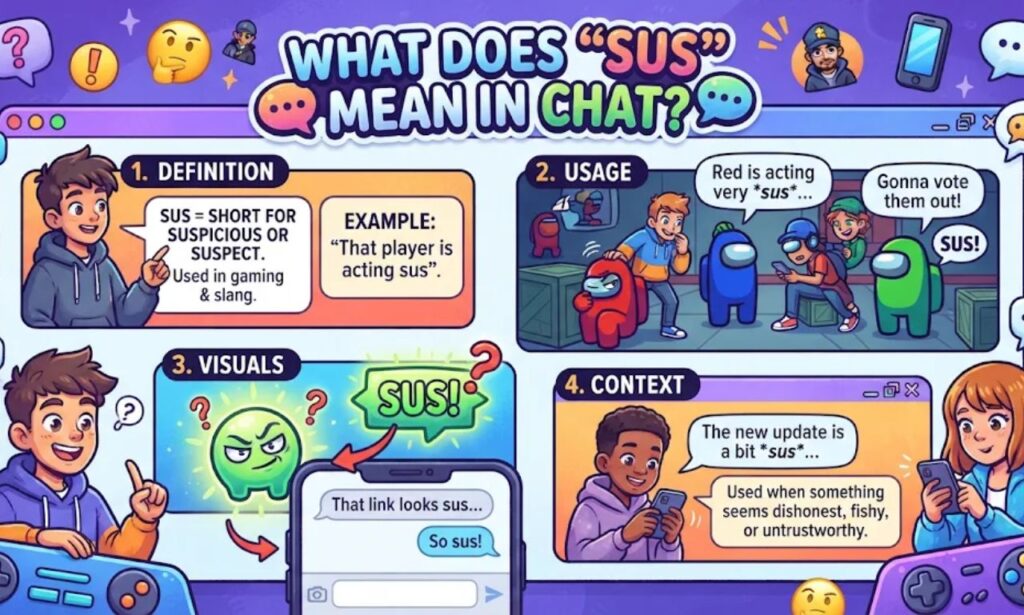
At its core, “sus” is a truncated version of the word “suspicious” or “suspect.” In a digital environment where speed is king, users often strip away extra syllables to convey a message instantly. When someone uses this term, they are flagging a behavior, a statement, or a situation as untrustworthy or “off.” It is the ultimate vibe check of the modern era, used to signal doubt without the need for a lengthy explanation.
Semantically, the word functions as a versatile adjective. It can describe a person acting strangely, a link that looks like a phishing attempt, or a story that doesn’t quite add up. Because instant messaging platforms like WhatsApp and Discord prioritize rapid-fire exchanges, “sus” has become a vital tool for social signaling. It allows a participant to cast doubt on a claim while maintaining the flow of a fast-moving conversation.
Origin of the Word “Sus” in Internet Slang
While many believe “sus” is a product of the smartphone era, its linguistic roots go back much further. In the early 20th century, particularly in British English, “suss” was used as a verb meaning to “discover” or “figure out” (e.g., “to suss out the truth”). However, the internet slang version we see today is a reimagining of that concept, shifting from a verb of discovery to an adjective of accusation.
The transition into digital communication began in the early 2000s on sites like Urban Dictionary, but it remained a relatively niche term for years. It wasn’t until the rise of social media and mobile-first culture that the word was distilled into its current three-letter form. This evolution represents a broader trend in modern lingo where words are adapted to fit the technical constraints of a keyboard or a character limit.
How “Sus” Became Popular in Online Gaming
The true catalyst for “sus” entering the global mainstream was the social deduction game Among Us, developed by Innersloth. During the global shifts of the early 2020s, this game became a cultural phenomenon. Players had to work together to maintain a spaceship while secretly identifying “imposters” who were trying to sabotage the mission.
In the heat of a “Meeting,” players had seconds to type out their defenses or accusations. Writing “Blue is suspicious” took too long; “Blue sus” was instant. This gaming culture necessity created a viral loop. As millions of people watched influencers on Twitch and YouTube use the term, it bled into everyday speech. The game provided a perfect laboratory for linguistic evolution, proving that the most efficient words are the ones that survive in high-pressure environments.
Common Examples of “Sus” in Conversations
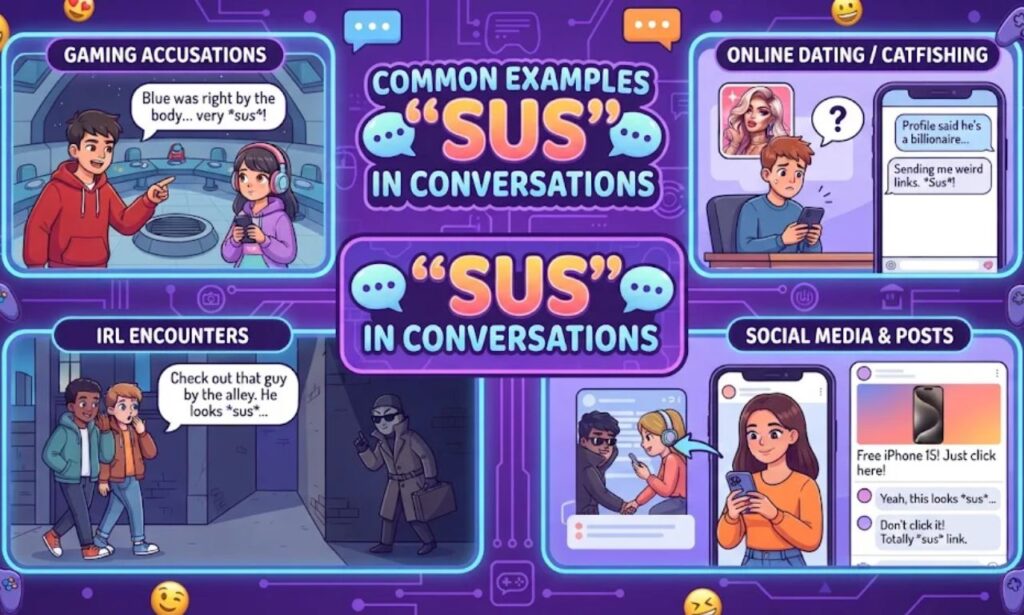
To understand how to use the term naturally, it helps to look at common interactions. The beauty of the word lies in its ability to carry different weights depending on the cultural nuance of the chat.
- Scenario A (The Skeptic): A friend claims they met a celebrity at the grocery store. You reply: “I don’t know, that sounds a bit sus.”
- Scenario B (The Warning): You receive a text from an unknown number asking for your bank details. You tell your group chat: “Just got a super sus text, stay safe.”
- Scenario C (The Joke): A friend starts liking all of their ex’s old photos. You comment: “Why are you being so sus right now?”
In each case, the word replaces more formal terms like questionable behavior or dishonest intent. It provides a way to confront someone without necessarily being aggressive, often keeping the tone lighthearted or “meme-adjacent.”
Different Contexts Where “Sus” Is Used
The meaning of “sus” can shift slightly depending on the digital “room” you are in. It is a highly contextual texting acronym that adapts to its surroundings.
| Context | Primary Meaning | Goal of Usage |
| Gaming | Potential Imposter | To alert the team of a traitor. |
| Dating Apps | Fake Profile / Bot | To avoid scams or “catfishing.” |
| Professional (Casual) | Project Risks | To highlight a part of a plan that seems flawed. |
| Social Media | Clickbait | To warn others that a headline is misleading. |
The data above shows that while the core definition remains the same, the intent varies. In a web chat regarding a business deal, “sus” might refer to untrustworthy data, whereas in a casual TikTok comment, it might just be a reaction to a weird video.
Similar Slang Words to “Sus”
“Sus” is part of a larger family of terms used to describe dubious or shady situations. If you want to expand your modern lingo, consider these alternatives that often appear in the same online conversations:
- Cap: Used to call out a lie. “That’s cap” is the logical follow-up if someone’s “sus” behavior is proven to be a lie.
- Shady: An older but still relevant term for someone acting with a hidden motive.
- Sketchy: Often used for physical locations or technical glitches that seem dangerous.
- Fishy: A traditional term that “sus” has largely replaced in younger demographics.
These words all deal with the concept of misunderstandings and the search for truth in an environment where not everyone is who they claim to be.
Why “Sus” Went Viral on Social Media
The virality of “sus” can be attributed to meme culture. Once a word is tied to a recognizable image or a funny soundbite, its usage skyrockets. On platforms like Instagram and X, the word became a “tag” that people could use to categorize content.
The Gen Z audience, in particular, values authenticity. “Sus” became a tool for gatekeeping that authenticity. If an influencer seemed to be faking a reaction for views, the comment section would be flooded with “sus.” This created a feedback loop where the word itself became a symbol of the internet’s collective “BS detector.” It is a low-effort, high-impact way to participate in a community discussion.
Real-Life Situations Where People Say “Sus”
Interestingly, “sus” has made the jump from instant messaging to verbal speech. It is not uncommon to hear it in high schools, universities, and even creative offices.
- In the Classroom: If a teacher gives a surprisingly easy test, a student might whisper that the situation is “sus.”
- At the Office: During a brainstorm, if a competitor’s numbers look impossible, a strategist might call the data “sus” to prompt a deeper look.
- In Parenting: Parents often use the term to bridge the gap with their children, though this can sometimes result in “cringe” if used incorrectly.
This transition from digital communication to physical reality is a hallmark of a word that has achieved true cultural saturation. It is no longer just a “computer word”; it is a human word used to describe questionable behavior.
Is “Sus” Still Popular in 2026?
As we move through 2026, many wonder if “sus” will face the same fate as “on fleek” or “swag”—terms that burned bright and then faded. However, “sus” seems to have more staying power. Its utility as a three-letter shortcut for a very common human emotion (suspicion) gives it a structural advantage.
Current trends show that while the Among Us memes have faded, the word has been integrated into the cultural nuance of the English language. It has become a “sticky” word because there is no other three-letter word that carries the same specific weight. In the era of AI-generated content and “deepfakes,” the need to call something “sus” is more relevant than ever. As long as the internet remains a place of mystery and potential deception, “sus” will remain a cornerstone of our online conversation.
FAQ’s
What does “sus” mean in a text?
It is short for “suspicious,” used to flag questionable behavior or untrustworthy claims during a quick online conversation.
Where did “sus” originate from?
It gained global fame through Among Us, where players used it as a texting acronym to identify the imposter.
Can I use “sus” at work?
Only in casual settings; it is internet slang and might cause misunderstandings in a formal, professional business environment.
Is “sus” still used in 2026?
Yes, it remains a staple of modern lingo for Gen Z and is vital for understanding social media trends.
What is a “sus” vibe?
It refers to a feeling that something is shady or dishonest, acting as a digital communication tool for skeptics.

Abu Bakar is the administrator of TechySerp.com with 2 years of experience in meanings and text explanations. He enjoys creating simple, clear, and informative content to help readers understand words and phrases easily.