

If you’ve ever scrolled through Instagram, TikTok, or a Reddit thread and spotted “TW” at the start of a post, you’ve likely wondered — what does TW mean? You’re not alone. Millions of people search for this abbreviation every month. In 2026, TW is one of the most widely used digital shorthand terms across all major platforms. Whether you’re a casual scroller, a content creator, or someone who wants to communicate more responsibly online, this guide covers everything you need to know about TW meaning, usage, context, and digital etiquette.
What Does TW Mean? 🤔
Simple Definition:
TW stands for “Trigger Warning.” It is a short notice placed before content that may be emotionally distressing, psychologically sensitive, or potentially harmful for certain readers or viewers.
In plain terms: before sharing something difficult, you type TW first — so the other person knows what’s coming.
Purpose:
The core purpose of TW is to give people a choice. It allows readers and viewers to either:
- Mentally prepare before engaging with sensitive material
- Decide to skip the content entirely if it may harm their mental wellbeing
- Feel respected and seen by the person sharing
A simple “TW: self-harm” or “TW: violence” at the top of a post does more than save space — it builds trust and shows emotional awareness.
Why Is TW Important in Online Communication 💬
The internet is fast, loud, and often unpredictable. Anyone scrolling through their feed can unexpectedly land on content about trauma, abuse, mental health crises, or graphic events. For someone with lived experience related to those topics, encountering such content without warning can cause real psychological distress.
TW exists to prevent that. It is not a trend or a buzzword — it is a form of digital care. In online communication, especially across anonymous or semi-anonymous spaces, using TW signals:
- Empathy — you’re thinking about how your words affect others
- Awareness — you understand that not everyone is in the same mental state
- Responsibility — you’re taking ownership of the content you share
Research published in the Proceedings of the ACM on Human-Computer Interaction (2024) confirms that most social media users hold positive attitudes toward trigger warnings, viewing them as a valuable courtesy in digital spaces.
Read This: What Does Fien Mean? Name Meaning & Significance 2026
Origins of TW (Trigger Warning) 📚
The phrase “trigger warning” did not start on TikTok. Its roots go back much further.
The concept emerged from mental health and trauma psychology communities in the late 1990s and early 2000s. Online forums discussing abuse recovery, PTSD, and mental illness began using written notices to flag potentially distressing discussions. The shorthand “TW” developed naturally as these communities grew.
By the early 2010s, Tumblr, Twitter, and Reddit brought TW into mainstream internet culture. Personal blogs dealing with topics like eating disorders, self-harm, and sexual assault started routinely prefacing posts with TW labels.
Around the same time, universities and academic institutions began experimenting with TW in course syllabi, particularly for literature or media covering trauma, war, or violence. This sparked a broader cultural conversation about mental health awareness in everyday communication.
Today, TW has evolved from an activist-era term into a universally understood digital courtesy — used by content creators, mental health advocates, journalists, educators, and everyday social media users alike.
How TW Is Used in Texting and Social Media? ✨
Using TW correctly is simple, but placement and clarity matter a lot.
Common Formats:
| Format | Example |
| Basic format | TW: [topic] |
| Before a paragraph | TW: eating disorders — I want to share my story… |
| In a caption | “TW: violence. This video contains graphic footage.” |
| In a thread | “Thread on grief. TW: death, loss.” |
| In texting | “TW: self-harm. Just need to vent about something.” |
The key rule: TW always comes first. Placing it at the end defeats the purpose, since the reader has already seen the content.
You can also stack multiple warnings when needed:
- TW: abuse, violence, trauma
Common Topics That Use TW ⚠️
TW covers a wide range of emotionally sensitive subjects. While there’s no official universal list, these are the most commonly flagged categories in online spaces.
Table: TW Examples by Topic
| Topic | Example Usage |
| Self-harm | TW: self-harm — discussing recovery journey |
| Mental health | TW: depression, anxiety — personal update |
| Eating disorders | TW: ED — my experience with body image |
| Violence | TW: violence — news clip contains graphic content |
| Sexual assault | TW: SA — sharing a survivor’s story |
| Death/grief | TW: death — remembering someone I lost |
| Abuse | TW: emotional abuse — unpacking a toxic relationship |
| Addiction | TW: substance use — honest talk about recovery |
| Trauma | TW: trauma — processing a difficult event |
| Racism/discrimination | TW: racism — discussing a real incident |
TW vs CW: What’s the Difference? 📝
Both TW (Trigger Warning) and CW (Content Warning) serve a similar purpose, but they carry slightly different meanings. In practice, many people use them interchangeably — but there is a meaningful distinction.
Comparison Table:
| Feature | TW (Trigger Warning) | CW (Content Warning) |
| Stands for | Trigger Warning | Content Warning |
| Focus | Personal trauma reactions | General sensitive content |
| Specificity | More targeted | Broader in scope |
| Example use | TW: sexual assault | CW: nudity, blood |
| Common platforms | Twitter/X, Tumblr, Reddit | Mastodon, Tumblr, TikTok |
| Tone | Clinically aware | Editorially neutral |
Key takeaway: TW is typically tied to trauma-specific triggers, while CW is used for content that may simply be upsetting or graphic without necessarily being a trauma trigger. Some communities prefer CW because it avoids placing a judgment on what counts as a “real” trigger. Both are valid, and both show respect for your audience.
Emotional Impact of TW 💖
A well-placed TW does more than just inform — it communicates something deeply human: I see you, and I don’t want to hurt you.
For people managing PTSD, anxiety disorders, depression, or trauma histories, unexpected content exposure can disrupt an entire day. A panic attack triggered by an unwarned social media post is not dramatic — it is a very real physiological response rooted in the nervous system.
Conversely, for those not personally affected by a particular topic, a TW takes two seconds to read and costs nothing. The asymmetry is stark: low effort for the creator, potentially huge protection for the reader.
That said, it’s worth noting that trigger warnings work best when they are specific and upfront. Vague TWs like “TW: bad stuff” don’t allow readers to make informed choices. The more precise the warning, the more helpful it is.
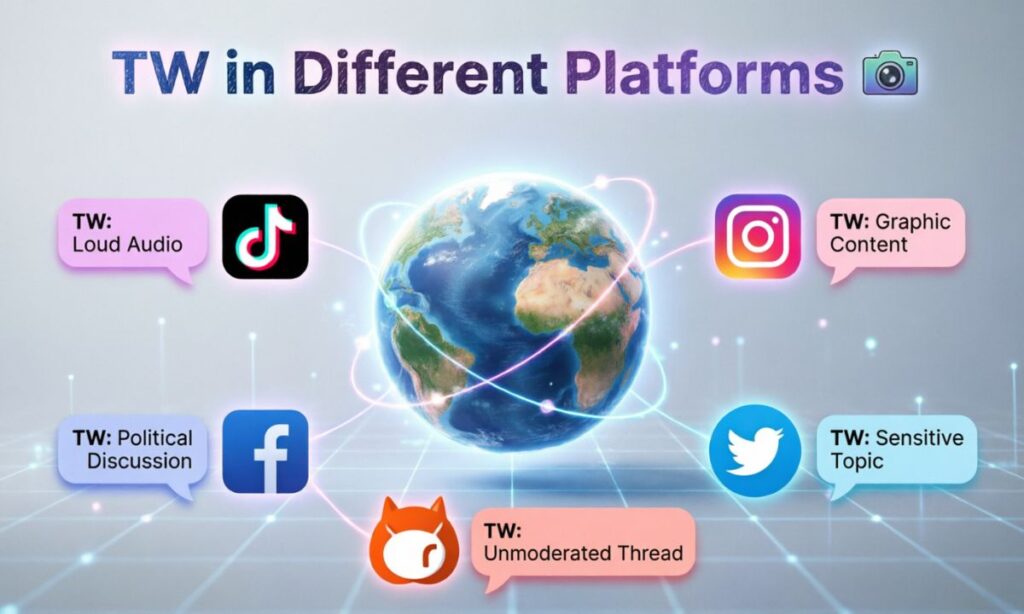
TW in Different Platforms 🌐
Social Media:
- TikTok — Creators add TW in video captions or speak it aloud at the start. TikTok’s own safety policies now encourage content labeling for sensitive material.
- Instagram — TW appears in post captions or story text. Commonly used by mental health advocates.
- X (Twitter) — TW has been standard practice for years, especially in threads discussing trauma or activism.
- Reddit — Subreddits like r/mentalhealth and r/CPTSD require TW labels in post titles for relevant content.
Messaging Apps:
In WhatsApp, Snapchat, Discord, and iMessage, TW appears in group chats when someone shares a news article, video, or personal story that touches on heavy topics. It’s a way to prepare recipients before they tap “play” or open a link.
Blogs & Articles:
Long-form writers include TW at the very beginning of a post — often before the introduction — when the article covers topics like domestic violence, mental illness, or historical atrocities. Some writers bold the warning or set it in italic text for visibility.
Videos:
YouTubers and podcasters often verbally issue a TW at the start of an episode, or include it in the video description. Some place TW cards as on-screen text during the first few seconds of a video.
How to Use TW Correctly? 🔍
Using TW well comes down to three things: placement, specificity, and consistency.
- Place it first. TW should appear before any related content — at the top of a post, the start of a caption, or the opening line of a message.
- Be specific. “TW: suicide” is more useful than “TW: dark content.” Tell people exactly what they’re being warned about.
- Use a colon or dash. Standard format is TW: [topic] or TW — [topic]. Keep it clean.
- Don’t add sarcasm. TW is a sincere warning. Using it ironically can confuse or offend people who rely on it.
- Repeat when necessary. In long threads, you may need to restate the TW partway through if the content escalates.
When Should You Use TW? 📌
Use TW any time you’re sharing content that could cause emotional distress to someone with related lived experiences. Good indicators include:
- The topic involves trauma, loss, abuse, or crisis
- You’re discussing mental health struggles in depth
- The content contains graphic descriptions or imagery
- You’re sharing news stories involving violence or disaster
- Someone in your audience has disclosed sensitivity to the topic before
- You’re unsure — and it’s better to be safe
When in doubt, add it. No one has ever been offended by a considerate heads-up.
Common Mistakes When Using TW ❌
Even well-meaning people misuse TW sometimes. Here’s what to avoid:
- Placing TW at the end of a post instead of the beginning
- Being too vague — “TW: upsetting” tells readers almost nothing
- Forgetting to use it at all when discussing heavy topics publicly
- Using TW sarcastically for non-sensitive content (e.g., “TW: I got a bad haircut”)
- Stacking too many unrelated warnings that bury the actual content
- Assuming TW makes the content okay for everyone — it reduces harm, but doesn’t eliminate it
TW in Modern Digital Culture 🔥
In 2026, TW sits at the intersection of mental health awareness, online safety culture, and everyday communication. It has moved from niche activist spaces into mainstream conversation, used by everyone from celebrity influencers to academic professors.
The rise of trauma-informed content creation has made TW a baseline expectation on platforms like Tumblr, Reddit, and increasingly TikTok. Brands, media organizations, and even government health agencies have adopted content warning practices inspired by grassroots TW culture.
Critics have debated whether TWs are always effective or sometimes counterproductive — but research trends consistently show that most users appreciate them, particularly those from marginalized communities who experience disproportionate online harm.
TW in Real-Life Conversations 🗣️
TW isn’t limited to the internet. In face-to-face settings and voice conversations, people increasingly say things like:
- “Trigger warning before I say this — it involves some dark stuff.”
- “Just a heads up, this story gets heavy. TW for abuse.”
In group therapy, counseling sessions, support circles, and classrooms, verbal trigger warnings have become standard practice. The digital shorthand TW has helped normalize this courtesy across all forms of communication.
Creative Examples Using TW ✨
Here are real-world examples of TW used naturally across different contexts:
Text message:
TW: anxiety. I had a really rough day and need to talk. Can we call?
Instagram caption:
TW: eating disorder recovery. Sharing my progress from last year — this is my honest story.
Reddit post title:
[TW: grief] Lost my dog this week. Just need somewhere to share.
YouTube description:
TW: violence, war footage. This documentary explores the realities of conflict zones. Viewer discretion is strongly advised.
Discord message:
TW: abuse — wanted to share something I read today that hit close to home.
Read This: What Does NNN Mean? Explained Clearly 2026
TW and Digital Responsibility 📚
Using TW is an act of digital citizenship. As online communities grow more diverse — in age, background, culture, and mental health history — responsible communication becomes a shared obligation.
Every person who adds a TW to their post contributes to a healthier digital environment. It sets a norm: that empathy matters, that readers are human beings with histories, and that two characters typed before a sentence can make a real difference.
As content creators, commenters, and everyday users, we all shape what online culture looks like. TW is a small tool — but it represents a larger value: putting people first.
Conclusion
TW, short for Trigger Warning, is one of the most meaningful abbreviations in modern digital communication. It started in mental health communities, grew through social media culture, and is now a standard courtesy across texting, blogging, video content, and face-to-face conversations. Knowing what TW means — and how to use it correctly — makes you a more considerate, responsible, and effective communicator in 2026 and beyond.